Try a Free Polish Lesson !!

#1 effective Polish teaching program for children
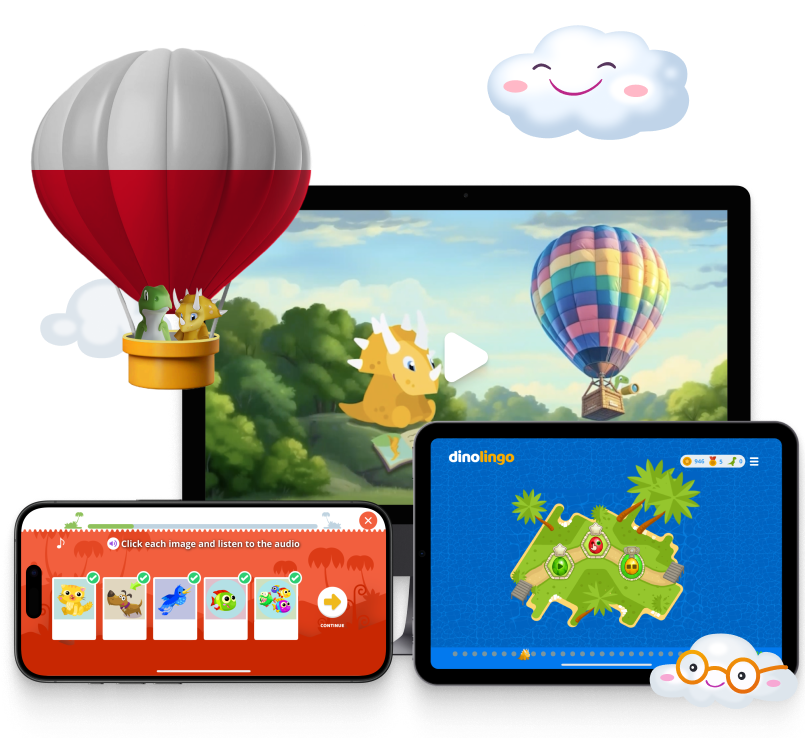
Children can quickly learn and speak Polish, thanks to the award-winning lessons by Dino Lingo Kids

Whats is in the "Polish for kids" DVD set ?
Dino Lingo Polish for Kids learning program teaches the most common 200 Polish words and phrases in 5 DVDs.
DVD 1 – Let's Count : Numbers and colors / 35 min.
DVD 2 – Let's Eat : Food, fruit and vegetables / 35 min.
DVD 3 – Let's Play : Toys, house items, vehicles / 35 min.
DVD 4 – Let's Jump : Verbs, actions and nature / 35 min.
DVD 5 – Let's Learn : Family, body parts, and clothes / 35 min.
Daily conversations and animals are included in all five DVDs.
Polish learning flash cards for kids
Dino Lingo Polish learning flash cards teach the most common one hundred words in Polish. Each flash card set comes in a small clear box contains 100 flash cards.
Flash card set categories: Numbers, colors, food, fruit and vegetables, house items, body parts, family, clothes, vehicles and nature.


This picture dictionary has colorful photos of the most common 45 animals. Great to test your child’s learning progress and play “spot and name.”
Categories: Pets, farm animals, sea animals, wild animals, birds, insects and reptiles.

This poster has the most common fourty five animal cartoon images.
Categories: Pets, farm animals, sea animals, zoo animals, birds, insects and reptiles.

This 12 month one side calendar has the cutest little dinosaurs.

Dino Lingo Parents Guide is designed to help parents learn how to teach a foreign language to children.
We make it easy and fun to learn the Polish language for children.
Full immersion: Our program is presented in Polish, no translations or confusions.
Contextual variation: During the DVD each word is presented at least in four different contexts, such as: cartoon image, cartoon animation, real image, real video, etc...
Gradual interval recall: All words and phrases are repeated several times throughout the DVDs.
Subtitles: All words have Polish subtitles.
For more detailed info on our method, please check Dino Lingo method.
DVD formats and Shipping
DVD formats : (All regions)
Our DVDs play in any DVD player worldwide. US, Canada, UK, Australia, Japan, and any country in Europe, Asia and Africa. Also they play in every computer.
Shipping : We ship anywhere.
US Standard shipping: $5.95
International Standard shipping: $9.95
Tax : There is NO TAX,
only Florida (US) residents pay 6% sales tax.
Click here for more on Shipping, DVD formats and International orders
# 1 Skuteczny Polski
Program nauczania dla dzieci
Dzięki wielokrotnie nagradzanemu programowi Dino Lingo Kids, dzieci mogą szybko nauczyć się mówić po polsku.
Polish learning program for kids by Dino Lingo
Dino Lingo understands that learning the Polish language for children is different than it is for adults. Polish learning for kids requires a radically different approach. Our Polish lessons for children use fun DVDs, books, flash cards, games, songs, and online lessons. With our approach children learn to speak Polish in a more organic, less regimented way. Our program makes learning Polish for children fun. Soon children understand and speak Polish in a naturalistic manner. There's never been a more powerful and easy method for teaching Polish to a child. No other lesson system or course is quite like it.
Our award winning Polish teaching method incorporates the stuff kids love with results that are truly amazing and praised in testimonials and reviews by parents and schools alike. In short, Dino Lingo gets results. Our animated dinosaur characters do the Polish teaching in the most efficient way. The results are linguistic magic. Our system of Polish learning DVDs, books, flash cards, games, songs, online lessons and cartoons gets your kid motivated, fully engaged, and speaking Polish fast.

How to teach kids Polish ?
Motivation Motivation Motivation
It's extremely important that kids have motivation to learn Polish. How to increase their motivation is not as difficut as you might think.You can simply do the following
-Rewards
Offer them rewards for learning extra words or phrases (e.g. , a chocolate bar from Poland, a trip to a Polish restaurant, or his/her favorite place, such as an amusement park)
-Surprises
Especially for small children, including infants and toddlers, surprises are proven to increase motivation. If you play games like peekaboo (for babies) your child will be able to keep paying attention to the program.
-Fun
Playing games like hide and seek by counting in Polish or a cardboard game will do the trick.
-Keep it short and simple
Not only adults but also children automatically lose interest if what they are asked to do is difficult. When you ask them to learn only a few Polish words at a time, they will find the task more enoyable and increase their confidence in learning Polish.
Practice, Practice, Practice
Practice makes it perfect the old saying goes. If your child has no opportunity to practice what he/she learned, you can make sure that all the efforts are in vain.
-Test & quiz
You can speak to your child in Polish if you know how to speak Polish. If you don't know how to speak Polish, you can still ask questions like "what is "this" in Polish?" by showing an object. If you know a few words in Polish, you can show him/her 2 objects and ask "which one is "ser"?" Kids love drawing things, you can also play with your children and ask them to draw objects by calling object names in Polish, e.g. "can you draw me a jajko?"
-Talking with native speakers
Another way of practicing Polish is giving your child opportunities to interact with native speakers of Polish. It would also be a fun family activity to visit a place where Polish is spoken such as a Polish restaurant, Polish supermarket, Polish culture center, Polish temple, Polish school, Polish community center etc.
-Flash cards
Flash cards might sound like an old school method but they are effective. Similar to Dino Lingo motion images, how flash cards work is very simple: they create object-sign associations in your childs brain after a short period of exposure. You can use Dino Lingo Polish Flash cards or make your own and practice with your child. If you are wondering about how to use Polish flash cards you can check out our blog post about Glenn Doman.
-Songs & Cartoons
Dino Lingo Polish is a perfect combination of songs and cartoons. You can also find tons of Polish songs and cartoons available online. It is also not a bad idea to buy some Polish children's song cd and play it in the car or at home as background music. Studies have shown that even background TV can increase children's vocabulary.
-Children's Stories
If your child knows some Polish, you can purchase Polish story books on the internet. If he/she doesn't know how to speak Polish, you can read fairy tales by replacing some words with Polish words.
Summary:
Let them watch Dino Lingo Polish videos regularly and play Dino Lingo Polish language online games.
Visit places where Polish is spoken such as Polish restaurants, Polish supermarkets, Polish culture centers, Polish temples, Polish schools, Polish community centers.
Play with fun educational stuff like Polish jigsaw puzzles and Polish toys. Don't forget the posters (Polish alphabet, sight words, Polish flag).
Interact with other kids who can speak Polish or studying together with someone with whom they can practice Polish.
How to raise a bilingual child - Polish ?
Its crucial that you talk to your child in Polish if you know how to speak Polish. Studies suggest that it's best to use "one parent one language method" which emphasizes that each parent consistently and only speaks his/her native language to the child. Try to avoid code-switching since children imitate their parents and might think switching languages is a normal thing to do when talking to others.
Polish fun facts, Poland
The symbol of Warsaw, Poland's capital, is a mermaid.
The symbol of Poland is a white eagle, and throughout the country's history, the eagle has sometimes been depicted wearing a crown or not wearing a crown, depending on the government and occupying nations of Poland. Currently, the eagle wears a crown.
Every hour, the trumpeter of Krakow plays the same melody from the top of a tower in the Krakow Square. However, he abruptly stops the tune in the middle of a note and never finishes. This symbolizes the original Trumpeter of Krakow, who, long ago, from the top of the tower, saw invaders coming and he played his trumpet to warn the citizens of the invasion and to tell them to flee the city. Many citizens heard him play and managed to escape, but as the invaders rode into town, one of them shot an arrow at the trumpeter and killed him while he was playing, interrupting his song. That's why today the trumpeter never finishes the song either, as a tribute to the trumpeter who saved the people of the city.
Fast facts:
Polish is the official language of Poland.
A total of 17 Poles won the Nobel Prize.
Two of the common Polish origin words found in English are schlub and schmuk.
Polish Proverbs
As a country with a unique and varied history, Poland has many sayings for many occasions and situations. Here are a few of them:
Common Polish Baby Names
Most popular Polish names for baby girls and baby boys as follow:
TOP 20 names for GIRLS
1. Julia 2. Aleksandra 3. Maja 4. Zuzanna 5. Lena 6. Wiktoria 7. Amelia 8. Oliwia 9. Natalia 10. Zofia 11. Nikola 12. Martyna 13. Emilia 14. Hanna 15. Alicja 16. Anna 17. Gabriela 18. Weronika 19. Maria 20. Magdalena
TOP 20 names for BOYS
1. Jakub 2. Szymon 3. Kacper 4. Filip 5. Michał 6. Mateusz 7. Bartosz 8. Wojciech 9. Adam 10. Wiktor 11. Piotr 12. Jan 13. Dawid 14. Mikołaj 15. Igor 16. Maciej 17. Aleksander 18. Antoni 19. Patryk 20. Dominik
Polish food
Poland is known for its hearty food, which keeps people warm and full during the long Polish winters. One of Poland's most famous foods is pierogi, which are large dumplings filled most often with potatoes, cheese, and onions, but they can also have meat or fruit inside. Gołąbki—which means "little pigeons" but is not made out of pigeons!—are large pieces of cabbage stuffed with ground meat and spices and cooked in tomato sauce. Soup is very popular in Poland, especially barszcz or borscht, made out of beets, or żurek, a sour soup with potatoes and vegetables. Potatoes and dark, thick bread are staples of Polish meals as well.
But Polish food is not all meat and potatoes: the desserts are very popular and can be found all over the country. It's very common for people in Poland to get together for tea and cakes, where they may eat pączki, which are jam-filled cakes kind of like doughnuts, eclairs, apple cake, or other cream-filled cakes. In Poland, it is traditional to eat dinner in the afternoon, around 1 or 2 p.m., which is the biggest meal of the day. In the evening, around 7 or 8 p.m., Poles eat "supper" which is a smaller meal, usually consisting of sandwiches or salads.
Golabki (Polish Cabbage Roll) :It's a traditional Polish disk made from boiled cabbage leaves wrapped around ground pork or beef with chopped onions, barley, and baked like a casserole with tomato sauce.
Goulasz (Goulash): In Poland, Goulash is a time of meat stew with paprika and vegetables.
Bigos ("Hunter's Stew") is the national Polish dish. There's no single reciple, since it varies from region and family but typically this meat stew is made of cabbage, saurkraut, varius cuts of meat and/or sausage, and tomatoes. Bigos is served with rye bread on the side or even inside a loaf of rye bread!
Makowiec: A pastry roll made with a rich filling forming a swirl of poppy seed spread.
Travel Poland, Places to visit
There are many famous places in Poland. Among them are the cities of Warsaw and Krakow, both of which have castles and Old Towns preserved the way they looked in the past.
Zakopane is a town in the Tatra Mountains in the south of Poland, and it is a small town right at the foot of very tall mountains, where much traditional culture is preserved. Not far from there, you can visit the Wieliczka salt mine, where you can take a tour of the underground caverns and see statues made out of salt. The Baltic Sea borders the north of Poland, where beach goers visit the cities of Gdansk and Sopot every year.
Verbal and non-verbal communication in Poland
Poles are known as talkative people who talk a lot, especially within their families. Women may also get together for tea and talk about their families, or anything else going on in the world.
Friendship is very highly valued, as is family, and when Poles see each other—or even meet each other for the first time—it is customary to kiss each other three times, once on one cheek, then the other, then back to the first. It is more common than shaking hands or hugging, and both men and women do this both for saying hello and goodbye.
Famous Polish stories, legends, epics
The founding of Poland is a famous legend in the country. There were three brothers, Lech, Czech, and Rus, who all went hunting together. Each of them followed a different prey, and they each went in different directions. Rus went east and ended up founding Russia, Czech went west and founded Czechoslovakia, and Lech followed his arrow and found himself facing a huge, fierce, white eagle. He took the eagle as a sign and decided to found his country in that place, and it became Poland. He named his city Gniezno (and in Polish, gniazdo means "nest", so the name of the city pays homage to the eagle), which still exists today, and he adopted the white eagle as the country's coat of arms. The white eagle is still the symbol of Poland today.
Another famous legend surrounds the Dragon of Krakow, who terrorized the land. No one could get rid of him, and the king announced that whoever could kill the dragon would be allowed to marry his daughter, the princess. Knights and soldiers from all over the country came to try to defeat the dragon, but no one could. Finally, a poor peasant boy came and filled sheepskin with poisonous arsenic and set them up along the riverbank so the dragon would think they were real sheep. The dragon saw the sheep and ate them, but the arsenic made him so thirsty, that he drank all the water out of the Vistula River and exploded. The peasant was successful and married the princess, and they lived happily ever after!
Festivals and holidays in Poland
The most important holidays in Poland are Christmas Eve and Easter. Christmas Eve, celebrated December 24th, is called Wigilia, and it celebrates the birth of Jesus. Traditionally, Poles put up a Christmas tree and decorate it with ornaments, stars, candy, and oranges, and presents are placed underneath it. The biggest meal of Christmas is eaten during Wigilia, and it contains no meat, but usually many fish dishes including carp and herring. The Christmas celebrations typically begin at the sighting of the first star in the sky (and the sun sets early in Poland in the winter, so the first star is usually seen around 3 p.m.), and families get together to eat and open presents. December 25th and 26th are considered the "second day of Christmas" and "third day of Christmas" and are celebrated with family get-togethers and holiday meals (this time containing meat). In many cities and villages, there is also usually a Christmas procession where people walk through the streets with candles, and end up in church to celebrate Mass.
Easter celebrates the resurrection of Jesus, and takes place on a Sunday in March or April. Easter is celebrated in Poland with the dyeing and painting of eggs (called pisanki) and an elaborate meal eaten with the family. A traditional cake called mazurek is made for Easter, and is a flat cake filled with chocolate or a caramel-like filling called kajmak. Common symbols of Easter are eggs, rabbits, and flowers.
The day after Easter is a children's holiday called śmingus-dingus, in which children pour water on each other, often after planning an elaborate ambush or hiding out to surprise their siblings or friends with the water.
Another traditional holidays is All Saints' Day (Dzień Wszystkich Świętych) on November 1, which celebrates the dead and people visit the graves of loved ones, leaving candles and flowers. In the evening, graveyards in Poland are lit up with candlelight and are eerily beautiful.
Traditional Polish clothing
Traditional Polish clothing is very colorful and decorative. In folk costumes, women wear long, colorful skirts with ribbons and printed with large flowers. They may wear white blouses and black or red vests (again embroidered with colorful flowers) and laced up across the front with red ribbon. They also wear necklaces made of red beads and wear their hair in long braids. They might also wear a wreath of flowers around their head. Girls will wear traditional leather or wooden shoes. Men's folk dress is similar: they wear tight white pants and a white jacket embroidered with red, black, and colored flowers. They wear a white shirt and a red tie, and a flat-topped black-and-red hat.
But while these outfits used to be common, now they are only worn for traditional festivals. Everyday dress in Poland is similar to that all over Europe and the United States. Many people wear jeans, suits, modern dresses, and modern shoes. Warsaw is considered a fashionable European city, so some of the newest fashion trends can be found there.